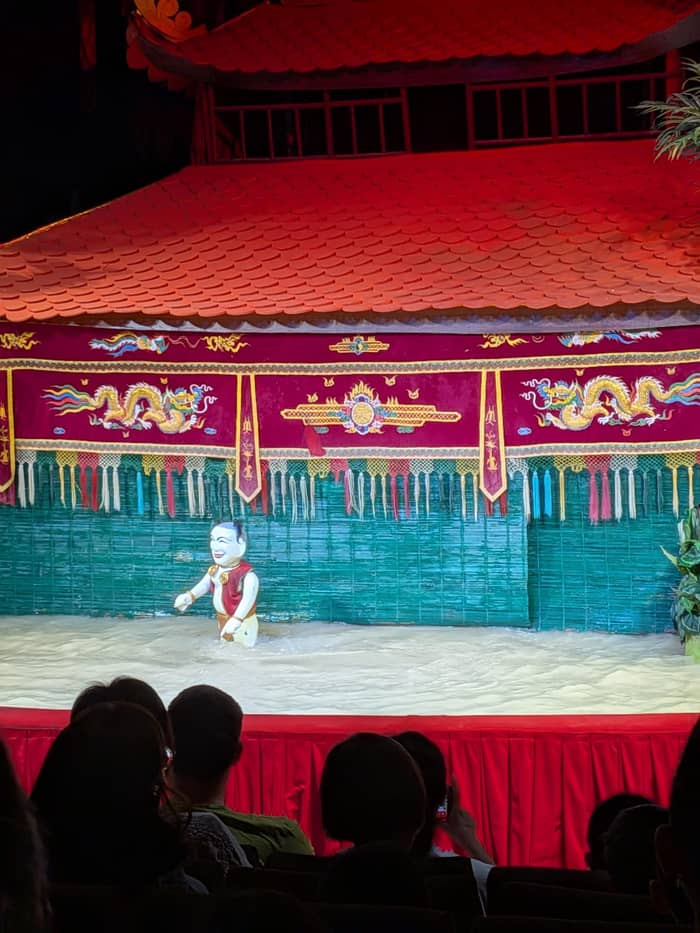
The show
The plain ticket
The show and nothing else
- Length45 to 75 minutes
- MusicLive orchestra
- CancellationFree up to 24 hours
Estimate your group cost
Compare 3 side by side
Choose your party size and compare ways to catch the show.
≈
View≈
View≈
ViewThese from-prices come from GetYourGuide and are converted using the ECB reference rate; the exact price shows at checkout.
How do water puppets work? The pool, the screen, the wooden puppets that float, the poles and strings below the surface and the musicians beside the stage, explained before the show.
Editorial team, saigonwaterpuppet.click · Updated November 16, 2026 · ~9 min read
Overview
Start with the surprise that sets the form apart: the stage is water. Nobody sits at a table moving figures on a floor. To see how Vietnamese water puppets work, start with the water. Today, according to Vietnam's national tourism authority, water puppet shows are given in pools of water and no longer in flooded rice paddies.6 The pool is a working stage, and the puppets cross its surface the way actors cross a floor, only with a trail of ripples behind them.
The pool is dressed to look like a sacred place. The same authority describes red tiered roofs, flags and parasols around it, arranged to resemble an altar inside a communal house.7 A Viet Nam News feature gives the building its own name, a thuy dinh, set up in communal ponds.8 That small pavilion at the back of the water matters more than it looks, because it is where the human side of the show is hidden.
The performers stand behind that screen. The authority places the puppeteers waist-deep in the water, out of sight behind the pavilion at the back of the stage.1 Government News adds that, traditionally, up to 8 villagers worked the puppets from behind a bamboo screen.9 From a seat in the theatre you see only wet wood sliding, bowing and fighting on the surface, and nobody holding it up. That gap between what you see and what is happening is the whole trick.
Anatomy of a show
| Part | What it is | How it works |
|---|---|---|
| Stage | A pool of water | The pool replaces the floor, with roofs, flags and parasols around it.6,7 |
| Screen | A bamboo or rattan curtain | It hides the puppeteers who stand waist-deep.9,22 |
| Puppet | Lacquered fig wood | The wood floats and the lacquer waterproofs it.2,14 |
| Control | Poles, strings, wires | Hidden rods and strings carry the movement to the surface.3,21 |
| Music | Live ensemble | Musicians and singers on either flank.4 |
| Host | Teu, the comic | He opens the show and leads the audience through the scenes.23 |
The parts are the same wherever the show is staged; troupes differ in the details of the instruments and the puppets.24,25
A basic requirement of the craft is that the puppet has to float. Fig wood floats, and the authority names it as the material of the puppets, with a lacquer finish on top.2 Viet Nam News describes the carving and waterproofing in plain terms: fig tree wood, sealed with resin from the lacquer tree.14 A feature on a village troupe adds that cluster fig is light, soft and durable, and that this lets the figures float easily on the surface.15
Size and weight depend on who is describing them, so here are the figures with their sources. Government News measures the typical puppet at about 60cm, mounted on a small wooden platform,16 and puts their weight between 5kg and 15kg.17 Viet Nam News gives a wider range, from 30 to 100cm, and describes the finish as red lacquer trimmed with gold.18,19 No source here sets a standard size, so read these as a rough scale and not as a specification.
What actually moves them is plain mechanics. Government News says puppeteers use string, wires and bamboo poles to make the figures glide across the water.3 The arms, the authority notes, work on bamboo sticks and strings,20 while another of its pages places rods and strings out of sight below the surface.21 The hidden hardware reaches from the puppeteers behind the screen to the puppet on the surface, and the water covers all of it.
The crew is the part of the art that is easiest to forget. Standing in the water for the full performance is hard physical work, the authority says, and the puppeteers lean on the movement of the water to build the drama and the illusion.29 It also says it takes decades to become a master.30 When a puppet seems to hesitate, wobble or turn its head, that is a person standing in the pool deciding to make it do so.
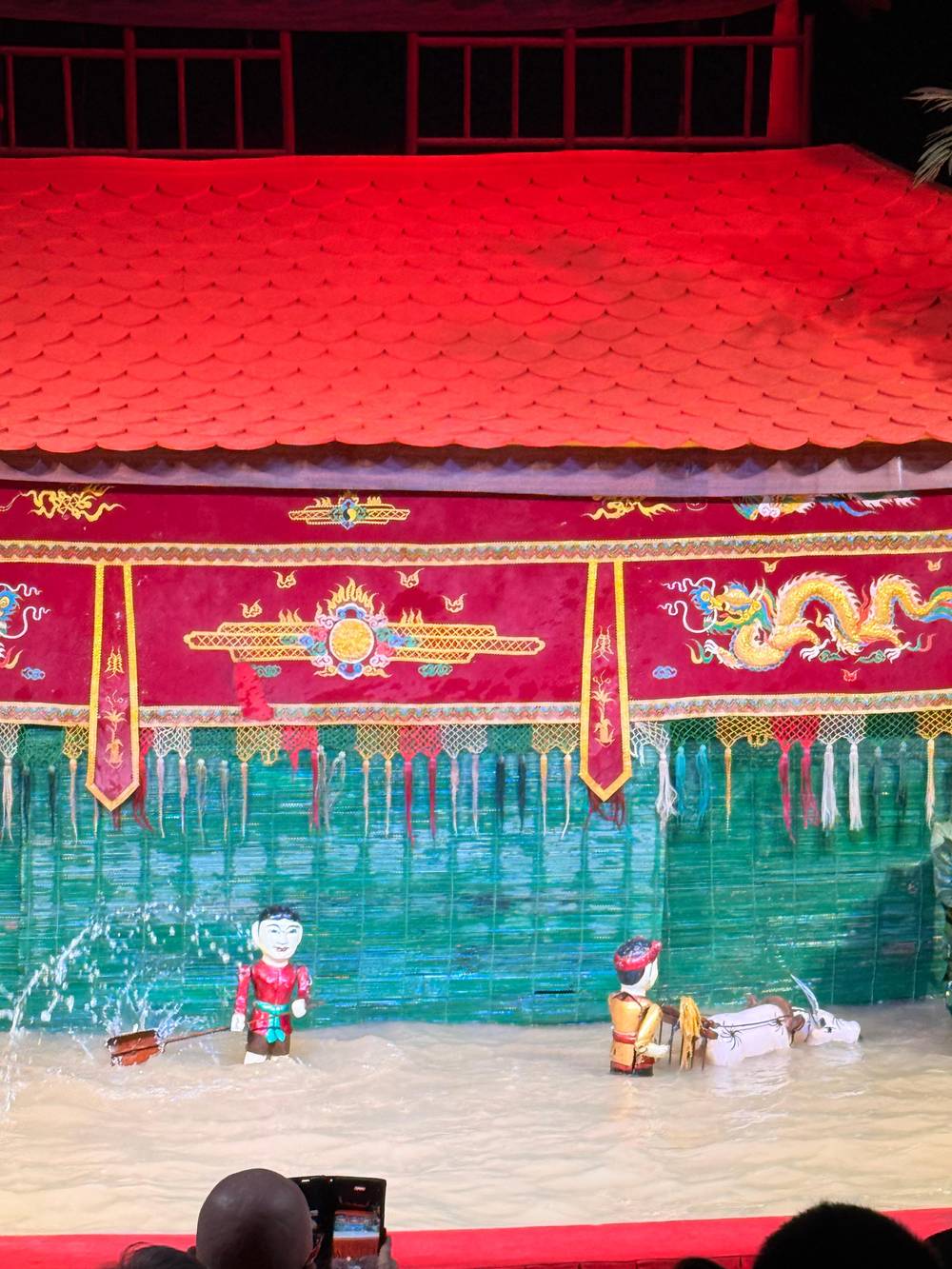
Some acts need several people to move as one. A Viet Nam News report quotes a Thang Long theatre director on a scene with a fox, a duck, a tree and a farmer.27 The act lasts 1 minute on stage, yet the artists practise it for 1 week, and the report adds that whoever handles the fox, the duck, the tree and the farmer must move together in harmony.31,32 A minute of laughter is built out of a week of rehearsal.
The craft survives because particular villages kept it alive. Government News names Thach That and Dao Thuc villages near Hanoi among the earliest known centres of the art, plus Rach in Nam Dinh and the Thai Binh villages of Dong Cac and Nguyen Xa.33 Dao Thuc is 300 years old as a village and is among the national intangible heritage entries compiled by the culture ministry.34 Another village, Dong Ngu, lost its puppets and water pavilions to wars, and its artisans began rebuilding in 1985.12
What to watch
Choose what interests you and see where to look when the show starts.
If I want to see how it is done
The final bow
The artists come out from behind the curtain at the end of the show.22
If I am here for the humour
The host and the fox
Teu opens the show, and a director of the Thang Long theatre describes a scene in which a fox goes after a duck.26,27
If I care about the music
The side of the pool
Musicians flank the pool.4
If I like craft and materials
The puppets' surface
The red lacquer is trimmed with gold on the Viet Nam News account.19
If I want the history
The village scenes
The scenes recreate daily life in northern villages.28
See it for yourself
The show
The show and nothing else
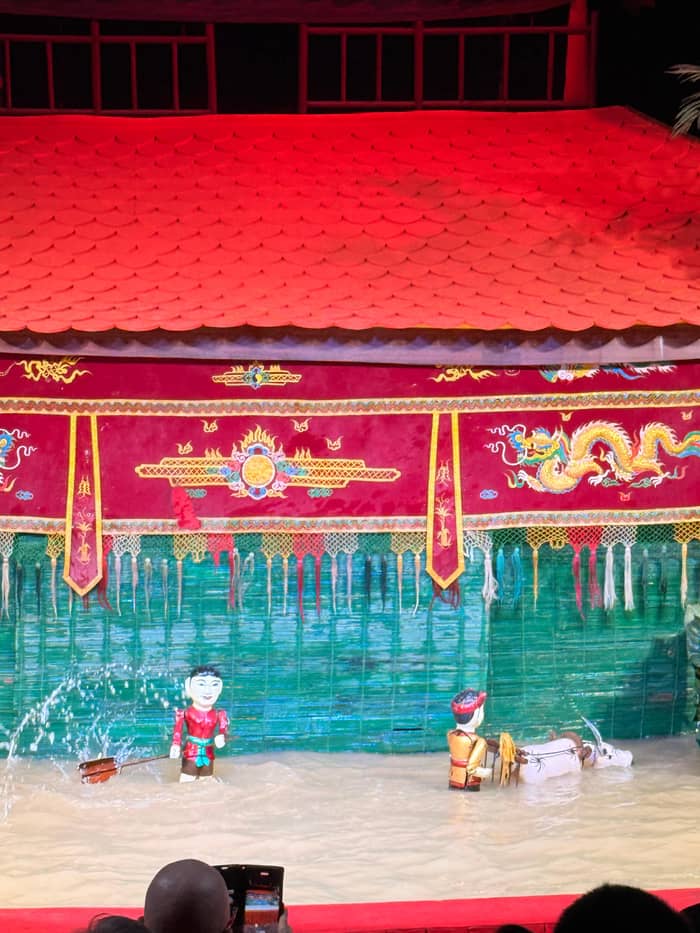
The show
A show only, skip-the-line label
The evening
An evening with a river dinner
Without music the puppets would be silent wood. Flanking the pool, according to the authority, are the musicians, whose voices and traditional instruments carry the stories.4 Government News is more specific and describes live cheo musicians with wooden bells, drums, flutes, horns and cymbals, plus singers.24 You hear the sound from the edge of the pool, where the players sit, and the sound and the picture arrive together as one performance.
Viet Nam News gives a different line-up that adds a fiddle and a 16-chord zither.25 The lists differ, and the useful point for a visitor is that the sound is live, answers the action and plays to the puppets, whose movements follow the pace set by the players.35 A village feature calls music an integral part of the show.36 Watch how the drumming sharpens a fight and how a flute softens a fishing scene.
The same report mentions that artists use firecrackers and fireworks for special effects in the play, which is a reminder that the show is theatre first and tradition second.37 At Dong Ngu the plays come with quan ho love duets, a local touch that marks that village's style.38 The words need not trouble you. Shows typically go without English, Government News notes, and the stories remain easy to follow thanks to the gestures and the music.39,40
The art through time
Village festivals
Water puppets were added to the festival performances about 1,000 years ago.5
Flooded paddies
The earliest shows used harvested rice fields that could be flooded with water.10
The royal court
Court performances came in the Ly period of the 12th century, when top troupes were picked to play for the king and guests.11
Hard years
At Dong Ngu village, wars destroyed the puppets and the water pavilions.12
Revival
The village artisans began to restore the art in 1985.12
Recognition
National intangible heritage status arrived in 2018.13
The tourism authority traces the art to farmers in the Red River Delta who gathered for folk singing and dancing at village festivals during the annual rice harvest.41 Its account puts the arrival of water puppets at about 1,000 years ago, on a stage made by flooding rice fields after the crop was in.5,10 Government News likewise traces the art to the 11th century and to the north's Red River Delta.42
Even the official stories vary on a point. Government News says villagers staged the shows to celebrate the end of the rice harvest,43 while a crafts page from the tourism authority says farming villages set up puppet stages in flooded paddies before the planting season.44 The accounts do not agree on the season, and no source here settles it. What they agree on is the setting: water among rice fields and a village audience.
The art moved from fields to palaces and back to theatres. By the 12th century, in the Ly Dynasty, the authority says, the court was picking out the best troupes to play for the king and his guests.11 It treasures the art as part of Vietnam's intangible cultural heritage,45 and Government News adds that national intangible heritage status followed in 2018.13 That is a long journey for a pastime that began as something to do after work.
Video
For 91 Days - Slow Travel Adventures on YouTube · Your tap on play is what loads the video.
Watch the wooden, lacquered puppets seemingly dance on the liquid stage, as they’re operated by puppeteers standing waist-deep in water, hidden behind the stage’s water house.
Before and during
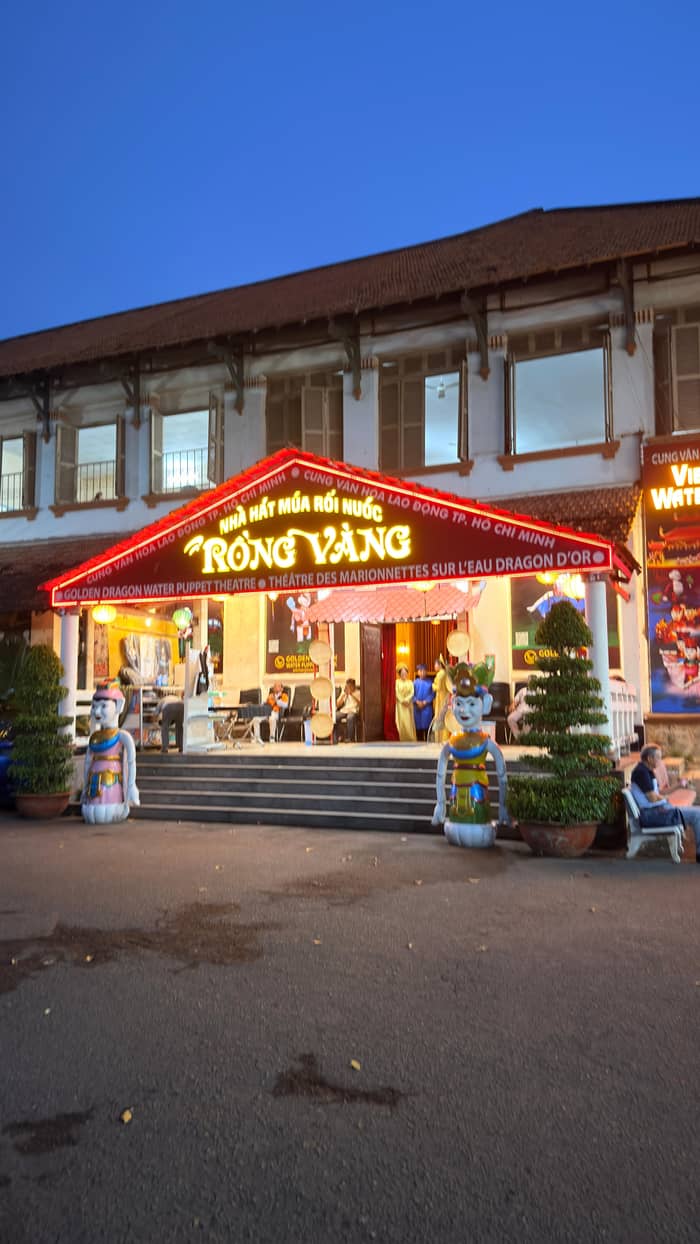
Water puppetry in Saigon is staged at the Golden Dragon Water Puppet Theatre, which Viet Nam News describes as presenting an art form that has thrived since the 11th century.46 The same newspaper places the show at the Ho Chi Minh City Palace of Culture and Labour, 55B Nguyen Thi Minh Khai Street, in District 1.47 The authority's list of venues in the city gives the same street address for the theatre.48
What you see there follows the pattern above. The site's ticket listing describes a live traditional orchestra and a stated duration of 45 to 75 minutes. Its own guide to the programme numbers the scenes up to 16 and names a host, a fox and ducks, fishing, a fairy dance and a boat race, all of which are the kind of village scenes the authority describes.28 Flash photography is not permitted in the theatre, so keep the phone camera dark.
Several cities host the art, and Government News names Hanoi, Hue, Hoi An and Ho Chi Minh City as places where shows are organised.49 The art began in the north, and the Saigon show performs it in a pool inside a cultural palace rather than in a village pond.42 The listing states that the performance is in Vietnamese, yet the mechanics described on this page are the same wherever you watch.
Once you know how it works, the show reads differently, and a few small habits of watching make it richer. Begin with the water itself, which is the part of the stage that tells the truth about what is going on beneath it. Look for the thin line of ripples where a pole pushes a puppet, and watch the water around the figures as well as the figures themselves. A striking moment is when a puppet seems to arrive from nowhere, which is where the hidden crew has timed a movement to the music.
Watch the host. Look first for Teu, the comic host, who by the authority's account is always the opening act and who guides the audience from scene to scene.26 Government News says Teu keeps reappearing to introduce characters.50 Treat his entrance as the cue that the programme has begun, and listen to the drummers who bring him in. Once the first scenes start, move your eyes between the puppet that is acting and the edge of the screen, where the poles and strings disappear, and notice how little of the hardware is ever in view.
Finally, stay for the end. A Viet Nam News report says audiences learn the trick when the artists step out from behind the rattan curtain at the close of the show.22 That bow shows the people who were waist-deep in water for the whole performance. Applaud them, and take a moment to notice how wet they are after standing in the pool for the whole programme. The effort behind the humour is part of the show, and it is only visible for those few seconds. It is a direct answer to the question of how water puppets work.
FAQ
Fig wood, which the authority describes as buoyant, with a lacquer finish.2
They stand waist-deep and hidden behind the stage's water house, according to the national tourism authority.1
Government News says puppeteers use string, wires and bamboo poles to make the figures glide.3
Shows are typically performed without English, yet Government News says the stories are not hard to follow.39
Teu always makes the first appearance in a traditional show, in the authority's account.26
The authority says water puppets joined village festival programmes about 1,000 years ago.5
The ticket listing says flash photography is not permitted in the theatre.
Sources
Planning an evening at the water puppets? Ask a real person here.