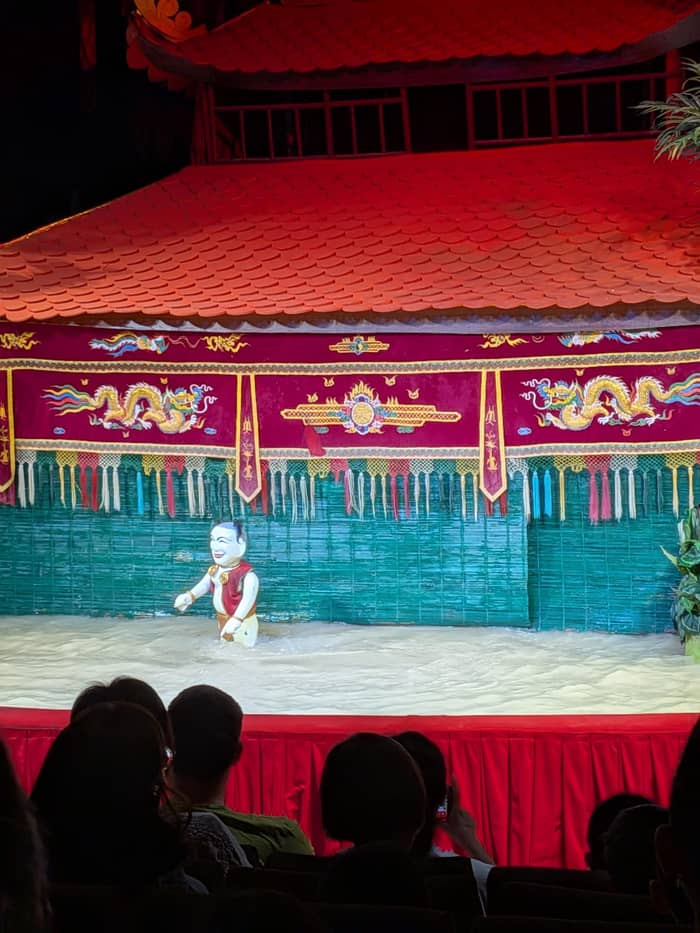
The show
The plain ticket
The show on the date you choose
- Fromfrom $17
- Reviews1,831
- Length45 to 75 minutes
Help me decide
A short quiz
Say what you want from the evening and the ticket that fits appears with its starting price.
Your top pick
from $17
A show ticket for the date you choose at the Saigon theatre, with a stated duration of 45 to 75 minutes and 1,831 reviews.
Your top pick
from $23
A show ticket with a skip-the-line label and a stated duration of 45 minutes at the same theatre.
Your top pick
from $77
An evening of 4.5 hours with the 45 minute show, then a dinner of 2 hours on a Saigon River boat.
Meet Teu the host, the fox and the ducks, the legend of the sword and the dragons, and learn what each scene in the programme is about before the lights go down.
Editorial team, saigonwaterpuppet.click · Updated November 16, 2026 · ~9 min read
Overview
A programme of water puppets in Ho Chi Minh City is a string of short scenes rather than one long play. Each scene has its own characters, its own bit of music and its own punchline, and the host stitches them into an evening. Viet Nam News lists scenes of everyday life, plays that present national heroes as examples and traditional opera such as cheo and tuong.6 A water puppet show in Ho Chi Minh follows the same scene-by-scene pattern, as the listing's guide below shows.
Daily life, in the authority's summary, means lively puppets acting out northern village routines, from royal parades and rowing boats to planting rice, fishing and minding ducks.2 Think of it as a gallery of rural pictures, each of them a few minutes long and each one played for the laughter of the audience. It adds that some shows depict Vietnamese folktales, which always carry a moral.3 Those strands, village comedy and old stories with a lesson, run through the whole programme.
The ticket listing for the Saigon show numbers the scenes of its programme up to 16 and names the ones it covers. The names that follow are taken from that guide, and the scene numbers are the listing's own. Treat them as a map of a typical evening rather than a promise, since a theatre can change the order of a programme, add a scene or drop one on a given night. Below, the scene groups follow the order of the guide.
Scene by scene
| Part | On stage | What it draws on |
|---|---|---|
| Host | Teu opens and guides the audience | A comic storyteller who leads the scenes.8 |
| Village life | A boy on a buffalo, farmers, fishing | Daily life in northern villages.2 |
| Fox and ducks | A fox swims after a duck and climbs a tree | A scene that takes 1 week of practice.15 |
| Legend | The restored sword | A legend tied to Hoan Kiem Lake in Hanoi. |
| Sacred animals | Dragon, unicorn, phoenix and turtle | Dragon dance and a unicorn fighting for a ball.4 |
| Finale | A boat race and a fairy dance | The fairy dance recurs in other troupes' lists.16 |
The scene names come from the Saigon listing's guide and the meanings from the official accounts cited here; a theatre can change its programme.
Everything starts with Teu. In the authority's account, the host Teu always makes the first appearance, and it describes him as an iconic, whimsical storyteller who steers you from one scene to the next.1,8 The Saigon listing places him in scenes 1 and 2 of its guide. He is a puppet, but he behaves like a master of ceremonies, and watching him tells you what the next scene is about.
Accounts of the tradition give Teu a few signature habits. Government News says the show began with the drummers, followed by the arrival of Uncle Teu, who keeps reappearing to introduce characters and scenes.9,10 Viet Nam News describes him as rotund and jolly, inviting the audience in the traditional way by offering betel leaves and areca nuts, and adds that children are most excited at receiving the leaf and nut.11,12
In one village troupe, Teu is also the star of an engineering trick. A Viet Nam News feature says that at Dong Ngu village his puppeteer uses pulleys and wires rather than stiff bamboo poles, which lets him go farther than other puppets.13 Another report calls Teu the most notable figure of the art, a storyteller who wins laughs by what he does.14 Whichever technique a troupe uses, the audience meets the same cheerful figure at the start, and it is worth noticing how he is moved and how he glides across the water before the next puppet arrives.
Counting the scenes
Counted from the numbered scenes that the listing's guide names; a scene number in the guide is not named.
After the host comes the countryside. The Saigon listing's guide names a boy on a buffalo and farmers in the rice fields in scenes 4 and 5, fishing and frog catching in scenes 6 and 8, and a fox and ducks in scene 7. That is village life in miniature, the same material that the national tourism authority lists when it mentions duck herding, fishing and rice planting.2 In the Golden Dragon water puppet programme these scenes follow the sacred animals of scene 3.
Other troupes play the same material in their own way. Viet Nam News says the classical repertoire of Dong Ngu includes buffalo fights, fishing, swimming contests and lion dances,17 and Government News lists typical skits such as Buffalo Fighting and Farming alongside Flag Raising, Swinging and Wrestling.16 Boys riding buffaloes are among the figures that Government News singles out for their cheerful, vivid look.18
The fox and duck scene has an explanation from the people who make it. A director of the Thang Long theatre told Viet Nam News that the fox swims after a duck, hides behind a bush and climbs a tree with it, and that the act lasts 1 minute on stage though the artists practise for 1 week.19,15 Watch for the moment when duck, fox, tree and farmer all have to be in the right place together.
Where to watch
The show
The show on the date you choose
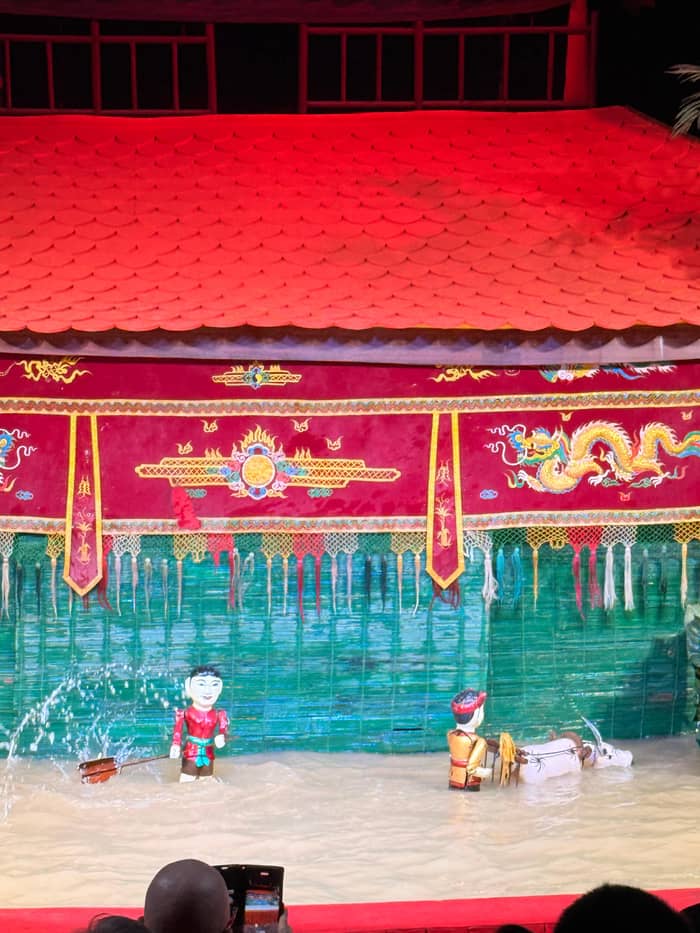
The show
A show only
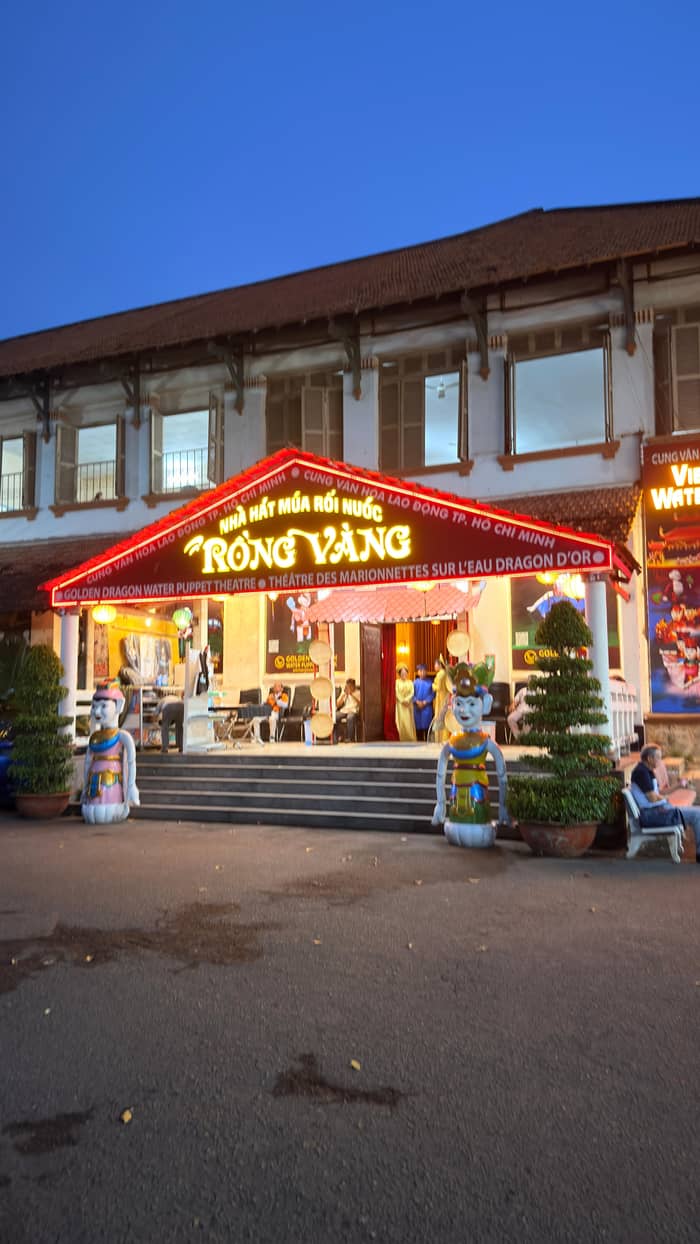
The evening
The show then a river dinner
Legends take the show beyond the farm. The Saigon listing's guide puts the legend of the restored sword in scene 11 and ties it to the origin of Hoan Kiem Lake in Hanoi. The national tourism authority says the Turtle Tower in that lake takes its name from a legend of a brave king, a magical sword and a mythical turtle.20 Anyone who has walked around the lake will recognise the setting, and anyone who has not will still follow the action on the water.
The sacred animals have a place in the programme too. The same guide places the dragon, unicorn, phoenix and turtle in scenes 3, 9, 10, 14 and 16. Viet Nam News mentions the dragon dance and a unicorn fighting for a ball among the scenes the audience sees,4 and Government News lists a Water-spurting Dragon and a Dance of the Four Sacred Creatures among typical skits.16 Government News also says dragons appear suddenly from underwater, which is a moment to watch for.18
New stories are being added to the old ones. Viet Nam News describes a newer piece, the Legend of the Fairy and Dragon, about the legendary origin of the Vietnamese people.21 In that story the love of the dragon father Lac Long Quan and the fairy Au Co gives rise to 100 siblings, who become the ancestors of 54 ethnic groups.22 Village troupes have also composed new pieces, such as the Mouse's Wedding and Offering Betel.23 The form keeps growing.
Price your evening
Enter who is going and compare the tickets that carry the programme.
Compare 3 side by side
Enter who is going and compare the tickets that carry the programme.
≈
View≈
View≈
ViewThese from-prices come from GetYourGuide and are converted using the ECB reference rate; the exact price shows at checkout.
A typical evening
Opening
Teu appears in scenes 1 and 2 of the guide.
Holy animals
Sacred animals dance in scenes 3, 9, 10, 14 and 16.
Village life
Scenes 4 to 8 move through rural harmony, fishing, a fox and ducks and frog catching.
The legend
Scene 11 tells a legend tied to Hoan Kiem Lake.
The finale
A boat race in scene 13 and a fairy dance in scene 15 close the programme.
The bow
The cast emerges from behind the screen to take a bow.7
The programme closes with a race and a dance. The Saigon listing's guide names a boat race in scene 13 and a fairy dance in scene 15. Government News lists a Dance of the Fairies among the typical skits of the art form,16 and a village troupe's list of new pieces carries a Fairies' Dance as well.23 That puts the fairy dance in more than one troupe's list, though what you see in Saigon is the theatre's own version of it, and it is worth watching for how the whole cast comes together on the water.
Set pieces like these are a good place to hear how the music and the puppets work together. Government News says the puppets' rhythmic dance changes with the tempo of the music,24 and a boat race or a dance is where that link is easiest to hear. Watch the drummers as the pace changes, and notice how the puppets move with the beat instead of against it, from the first splash of the race to the last bow of the dancers.
The moment the programme keeps for last is a reveal. A Viet Nam News report says the secret is revealed to the audience at the close, once the artists walk out from behind the rattan curtain.7 The bow turns an evening of apparent magic into a human achievement. Stay in your seat for it, and clap for the people who spent the whole show in the water behind the screen, because their work is invisible until that moment and it is easy to leave before it arrives.
Video
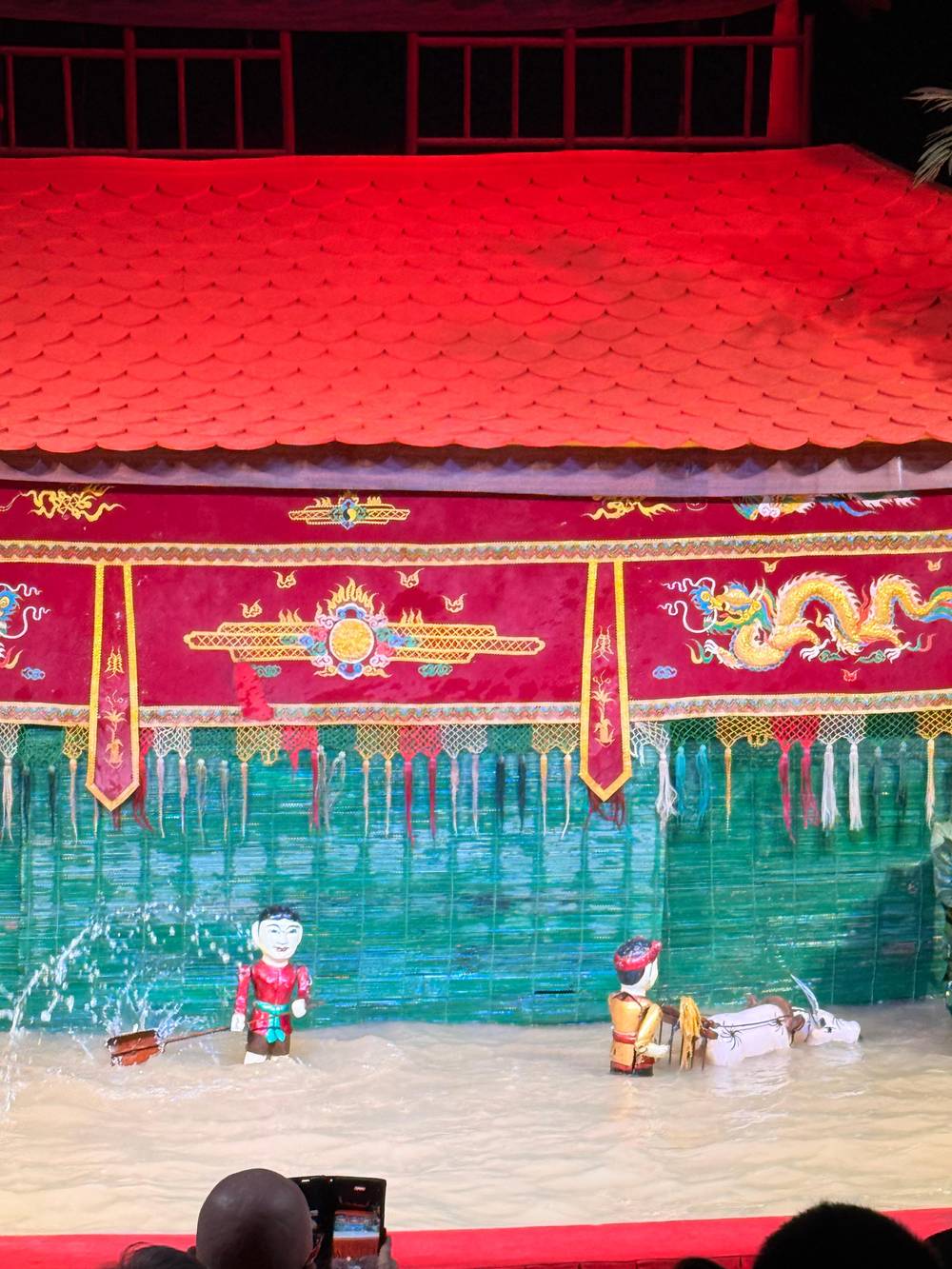
For 91 Days - Slow Travel Adventures on YouTube · Your tap on play is what loads the video.
The gestures of the colorful puppets and the beautiful music say everything best and keep shows entertaining.
Before you go
The soundtrack is part of the storytelling. Government News says the shows usually come with live cheo players, whose kit includes wooden bells, drums, bamboo flutes, horns and cymbals, plus singers.25 For the shows it describes, Viet Nam News names a drum, a two-stringed fiddle, a flute, a drum kit and a zither with 16 chords.26 Different troupes use different mixes, and the Saigon listing says only that a traditional orchestra plays live.
Learn to hear the cues. The authority places the musical ensemble to the left and right of the stage, using voices and traditional instruments to animate the stories.27 Drums sharpen the fights, flutes soften the fishing, and singing fills the gaps where dialogue would be. A troupe member insists the music is integral to the whole performance, and the live players sit there to answer what the puppets do on the water.28
Songs can mark a regional style. Village styles differ: the Dong Ngu troupe sings quan ho, a form of love duet, alongside its plays.29 The Saigon show does not claim that tradition, so do not expect the same songs. The sound you will hear is a stage orchestra at work, and a good way to enjoy it is to let it lead your eyes to the next puppet, and to the next change of mood, before the scene has fully appeared on the water.
Behind the jokes sits a purpose. Government News says villagers believed that puppet shows could teach their children the values of community life and pass on history and folk tales.30 The tourism authority says the folktales it describes always carry a moral,3 and another page of its own says the shows typically convey age-old folk tales with moral messages.31 In that sense the puppet stage works as a classroom as well as a theatre, with the host leading the lesson.
For visitors from outside Vietnam, the language need not be a barrier. Government News concedes the language gap but says the gestures of the puppets and the music tell the stories clearly.32,5 The ticket listing for the Saigon show says it is performed in Vietnamese. If you read the scene names beforehand, you will recognise the plot as soon as each puppet appears, and the humour will land before the music has finished its first phrase.
Children can turn the programme into a game. Viet Nam News says children are most excited by Teu's gift of a betel leaf and areca nut.12 Make a game of spotting the dragon, the fox and the boat race from the guide above, and let them guess who is hiding behind the screen. Ask them afterward which scene they liked and why, and listen for whether the answers follow the humour, the animals or the music. The show is a way to meet a piece of Vietnamese culture that was built to be shared with a whole village.
FAQ
Per the authority, a traditional show opens by introducing Teu, a comic host.1
The ticket listing says the show is in Vietnamese, and Government News says the stories are easy to follow regardless.32
A theatre director told Viet Nam News the fox swims after a duck and climbs a tree with it.19
The listing's guide names the dragon, unicorn, phoenix and turtle in scenes 3, 9, 10, 14 and 16.
Government News names wooden bells, drums, bamboo flutes, horns and cymbals, plus singers.25
The Saigon listing publishes a numbered guide, a typical programme and not a promise of the order.
Sources
Planning an evening at the water puppets? Ask a real person here.